Trading cards
Cards pulled from booster packs, filed in a binder, traded for what you are missing.
Trading cards are collectables. You pull them from booster packs, keep one of each in your binder, and trade your spares to other players for the ones you are short of.
Cards are ordinary items. You can hold them, drop them, trade them, sell them, and hang them on a wall as decoration.
#Reading a card
Hover a card in your inventory and it tells you everything about itself: its rarity, the set it belongs to, and, if it is ready to fight, the element it uses, the health, attack and defence it brings to a card battle, the level it is on, and every move it knows with what each one costs and does.
The stats shown are the stats that card fights with, so a card you have levelled up reads higher than a fresh copy of the same card. A card nobody has written battle stats for yet says so, and cannot go in a deck.
Your binder says the same things about every card in it, and a card you have not collected still shows what it would do in a fight, so you can see what is worth chasing before you own it.
#Your first pack
Every account gets one free starter pack. Click the card NPC and it hands the pack over, or run /starterpack if you would rather type it.
It is one per account, so there is nothing to come back for. The pack sits in your inventory sealed until you right-click it, so open it whenever you feel like watching the reveal.
#Booster packs
Booster packs come from crates and from the card pack storefronts around spawn. Right-click one to open it.
The pack rises in front of you face down, spins, and turns over one card at a time. You do not find out what you pulled until it flips. Whatever comes up is yours the moment you see it, so it is safe to walk away, get knocked off a ledge, or log out mid-reveal.
Shift right-click one instead and it opens with no reveal. The cards go straight into your inventory and a single line tells you how many arrived. Rare pulls are still announced network-wide, so you do not miss anything by skipping the show.
A pack holds a fixed number of cards, and each slot draws from its own pool. Nothing is guaranteed beyond what the pack's description says.
#Pack bundles
Some crates and storefronts pay a bundle instead of a single booster. A bundle is one sealed item holding several packs, and its lore lists exactly what is inside. A bundle can mix pack types, so one may hold two of a common booster and one of something rarer.
Right-click it and the packs drop straight into your inventory, still sealed. Nothing opens on its own, so you get to open them one at a time and watch each reveal properly. If your inventory is full the spares land at your feet.
Anyone nearby can watch your reveal by default. There are /settings keys to keep yours to yourself and to hide everyone else's, and separate ones for whether your rare pulls are announced network-wide.
#The binder
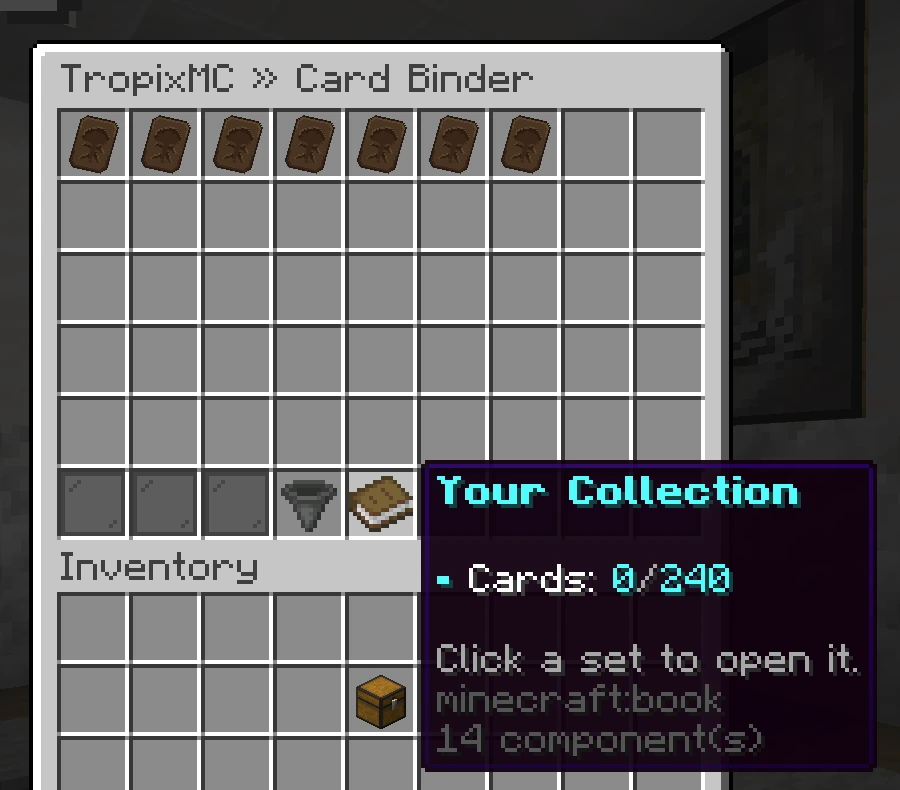
/binder (also /cards) opens your binder. It lists every set, with how much of each you have collected.
Open a set and you get a page with one slot per card, always in the same place. Cards you own show their art. Cards you do not show that set's card back, still named, so you know exactly what to ask for when you go looking for a trade.
- Click a card in your own inventory while the binder is open to file it.
- Click a card in the binder to take it back out.
- File Everything takes one of every card you are carrying that the binder is missing.
Your binder holds exactly one copy of each card. Every spare stays a loose item in your inventory, and that is deliberate: the spares are what you trade with.
Taking a card back out removes it from any deck that was using it, and you are told which. The deck keeps its name and its other cards; it just has an empty slot until you fill it.
#What a card looks like
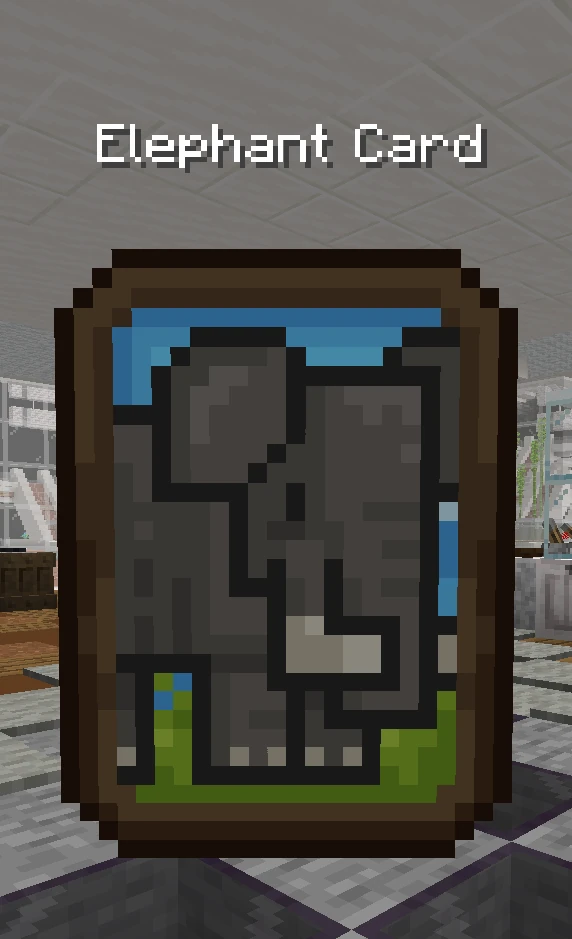
Every card is a framed picture of its creature standing in a scene that suits it: a plains card under an open sky, a nether card over basalt, a sculk card down in the dark. Each set has its own card back too, so a card lying face down on a wall, or an empty slot in your binder, already tells you which set it belongs to.
#Rarity
Every card has a rarity, and the colour of its name tells you which. Rarer cards appear in packs less often. The rarest ones are announced to the network when somebody pulls them.
You can also see it without reading anything. A common card is still. Rare and ultra rare cards move: the scene behind the creature drifts and glimmers the whole time you are looking at it, in your hand, in the binder, or hung on a wall.
Above ultra rare sits Secret, the rarest rung of all, with a gold name and a gold frame that moves along with the rest of the card. A set has at most one Secret card, it shows up in packs less often than any ultra rare, and pulling one is announced to the whole network. The first is The Wendigo, in the Halloween Macabre set.
#Completing a set
Fill in every card of a set and it counts as complete while those cards stay in your binder.
A complete set can carry a passive boost to one of the grinds, and the binder tells you which one and how much on every set's icon. It applies the whole time the set stays complete, with no cooldown and nothing to activate. Take a card out to trade it and the boost stops until you put one back.
Boosts from different complete sets stack, up to a ceiling. Not every set has one.
#Battling
Cards fight. Build a deck of five out of your binder and take it into the arena for a wager, or against the server for loot. See card battles.
#Missions
Milestone ladders count the packs you open, the cards you pull, every card you file into your binder for the first time and every set you complete for the first time. Taking a card out and filing it again does not count it twice.
#Leaderboards
Two card boards run alongside the others: most cards collected and most sets completed. Both count what you are holding right now, so trading a card away moves you down them. Find them on the leaderboard hub, and on tropixmc.net.
#Trading
Cards move like any other item, so all the usual routes work:
/tradeface to face.- The auction house for a network-wide market.
- Player shops to sell them passively from your island.
/binder <player> opens a read-only view of somebody else's binder. Use it to see what they are missing before you offer a trade.
#Next
- Card battles Fight with the cards you collect.
- Plushies The collection beside your binder.
- Crates Where booster packs come from.
- Trading Swapping spares face to face.
- Auction house Selling spares on the open market.